
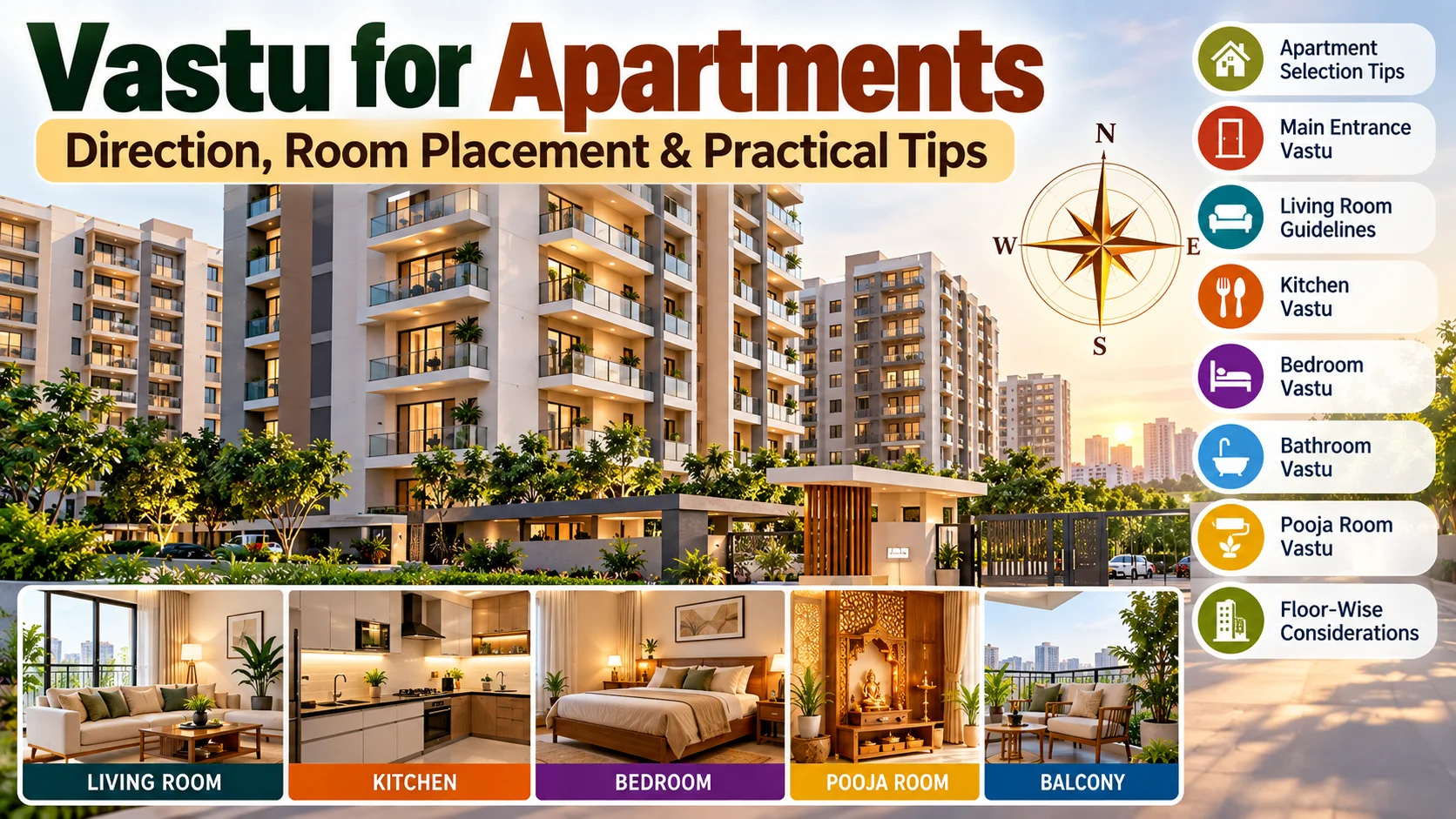
Vastu for apartments focuses on applying traditional Vastu principles to flats and high-rise homes where the basic layout is often fixed. Unlike an independent house, an apartment owner may have limited control over the entrance, kitchen, balcony, floor level and structural walls.
Even in a fixed layout, you can consider Vastu while choosing an apartment, arranging furniture and planning the spaces you can control. Practical factors such as natural light, ventilation, safety and comfort should also be considered.
What Is Vastu for Apartments?
Vastu Shastra is a traditional Indian system of architecture that gives importance to directions, room placement and the balance of the five elements: Earth, Water, Fire, Air and Space.
For apartments, the focus is usually on the direction of the entrance, room arrangement, kitchen placement, bedroom location, balcony, natural light and the use of available space.
Why Vastu Matters in Apartment Living
Apartment layouts are usually designed by builders, so residents may not be able to make major structural changes. This makes early planning and practical adjustments more useful.
- Review the apartment’s direction before buying or renting.
- Check the entrance and overall floor plan.
- Look at natural light and ventilation.
- Consider kitchen and bedroom placement.
- Plan furniture around the existing layout instead of forcing major changes.
Types of Apartments Based on Direction
Traditional Vastu considers different directions while evaluating an apartment. The direction of the main entrance and the complete internal layout are more useful to consider together than judging an apartment by one direction alone.
North-Facing Apartment
North is traditionally associated with wealth and opportunities. A clean entrance and organised north zone are commonly preferred. For a more detailed layout, see our guide to a north-facing house.
East-Facing Apartment
East is traditionally associated with the rising sun and is often preferred for light and activity. Apartments with suitable east-facing openings can be considered during selection.
West-Facing Apartment
West-facing apartments can also be considered when the internal layout, ventilation and room placement are suitable. Our guide to a west-facing house explains some of the same planning considerations.
South-Facing Apartment
A south-facing apartment should not automatically be considered unsuitable. The complete floor plan, entrance, shading, ventilation and internal arrangement should also be reviewed.
Key Vastu Guidelines for Apartments
Main Entrance
Traditional Vastu commonly gives preference to north, east or northeast entrances. Whatever the direction, keep the entrance clean, well-lit and free from unnecessary obstruction.
Kitchen
The southeast is traditionally preferred for a kitchen, while northwest is also mentioned as an alternative. The cooking area should be safe, organised and properly ventilated.
Living Room
North or east are commonly preferred areas for a living room in traditional Vastu. Keep the room open enough for comfortable movement and avoid blocking windows.
Bedroom
The southwest is traditionally preferred for a master bedroom. A bedroom should also provide privacy, ventilation and a comfortable environment for rest.
Bathroom and Toilet
Northwest or west are commonly mentioned in traditional Vastu for bathrooms. Regardless of direction, proper ventilation, drainage, cleanliness and moisture control are essential.
Pooja Room
The northeast or east is traditionally preferred for a pooja room. Keep the prayer area clean, peaceful and separate from unnecessary storage.
Vastu for Apartments Floor-Wise
Traditional Vastu discussions sometimes associate different floor levels with different uses. These views can vary, so floor number should not be the only factor when selecting an apartment.
| Floor Level | Traditional Consideration |
|---|---|
| Ground | Often associated with stability and easy accessibility. |
| First to Second | Commonly considered convenient for families. |
| Third to Fifth | Often viewed as suitable for professionals and families. |
| Sixth and Above | Higher floors may require more attention to ventilation, heat and accessibility. |
Apartment Vastu Checklist Before Buying or Renting
- Check the main entrance direction.
- Review kitchen and master-bedroom placement.
- Look for suitable natural light and airflow.
- Check the shape and usability of the apartment.
- Look at balcony direction and surrounding obstructions.
- Check bathroom placement and ventilation.
- Consider the actual floor plan rather than judging only by the entrance direction.
Common Vastu Concerns in Apartments
Some apartment layouts may not match every traditional Vastu preference. Commonly discussed concerns include a kitchen in a traditionally avoided zone, a toilet in the northeast, a heavy structure in the centre, irregular shapes or an entrance that does not match preferred directions.
These conditions do not automatically make an apartment unsuitable. Structural safety, comfort, ventilation, sunlight and practical use should also be considered.
Simple Vastu Adjustments for Apartments
When structural changes are not possible, focus on areas that you can safely control.
- Keep rooms and entrances uncluttered.
- Arrange heavy furniture thoughtfully.
- Use comfortable and suitable colours.
- Improve natural light and ventilation.
- Keep plants healthy and properly maintained.
- Use traditional Vastu symbols or decorative items according to personal belief.
There is no need to make expensive changes solely because a flat does not perfectly follow every Vastu preference.
Vastu for Rented Apartments
Rented apartments are often best suited to non-structural changes. Tenants can adjust furniture, lighting, colours, plants and storage without permanently modifying the property.
Focus on improvements that also make the apartment cleaner, brighter and more comfortable.
FAQs About Vastu for Apartments
Can Vastu be applied to apartments?
Yes. Traditional Vastu principles can be considered in apartment selection, furniture placement, room use, colours and other non-structural aspects.
Which apartment direction is considered favourable?
North and east are commonly preferred in traditional Vastu, while the complete floor plan should also be considered before making a decision.
Is a south-facing apartment bad according to Vastu?
Not necessarily. A south-facing apartment should be evaluated according to its entrance, internal layout, sunlight, ventilation and overall design rather than direction alone.
What is the best kitchen direction in an apartment?
The southeast is traditionally preferred, with northwest also mentioned as an alternative in some Vastu practices.
Can Vastu be followed in a rented apartment?
Yes. Non-structural changes such as furniture arrangement, lighting, colours, plants and organisation can be used without changing the building.
Do I need major renovation if my apartment does not follow Vastu?
No. Major renovation is not always practical or necessary. Start with simple changes that improve organisation, light, airflow and comfort.
Vastu for apartments is best used as a traditional planning framework for choosing and arranging a flat. Since apartment structures are often fixed, focus on the areas you can control while giving equal importance to safety, ventilation, natural light, drainage, privacy and everyday comfort.