
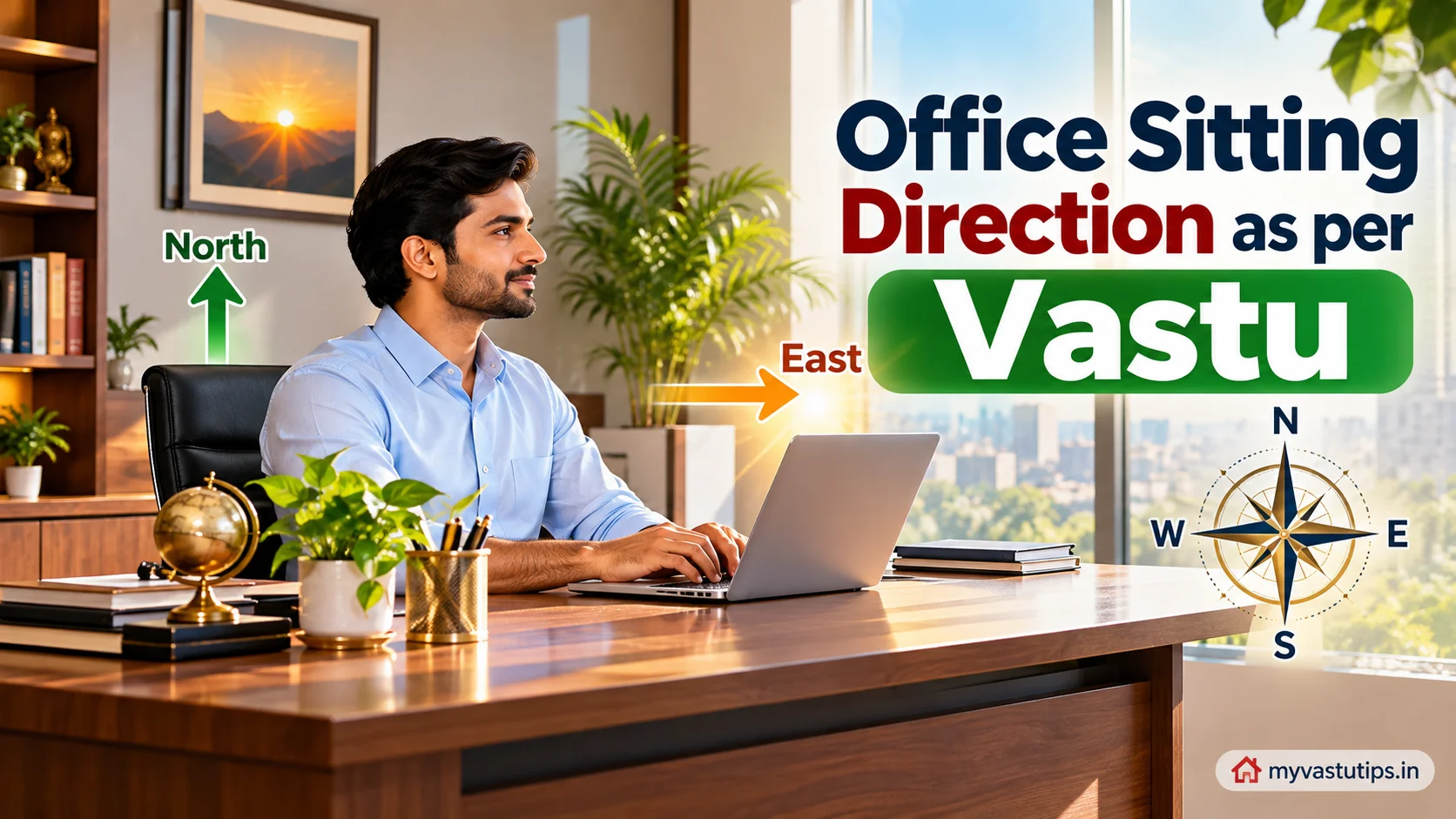
Office sitting direction as per Vastu is a commonly considered factor when planning a workplace. According to traditional Vastu Shastra, the direction a person faces while working and the location of the seat are linked with qualities such as focus, stability, confidence, and growth. A practical office should also provide good lighting, ventilation, comfort, and enough working space.
What Does Office Sitting Direction Mean in Vastu?
Two things are often confused in office seating: where you sit and which direction you face. They are not the same.
Your seat location means the part of the office where your chair and desk are placed, such as the southwest or west zone. Your facing direction is the direction you look toward while sitting and working, such as North or East.
A Vastu-based seating plan considers both factors together.
Best Direction to Face While Working in Office
Facing North
North is traditionally associated with wealth, opportunities, and career-related growth. It is commonly recommended for business owners, finance professionals, and people whose work involves numbers or financial decisions.
Facing East
East is associated with the rising sun and is traditionally linked with learning, creativity, fresh ideas, and activity. It is commonly preferred for employees, managers, marketing professionals, and creative work.
Facing West
West is traditionally associated with stability and consistency. It can be considered for technical, support, research, and routine work when North or East is not practical.
Facing South
South-facing seating is generally less preferred in traditional Vastu guidance for regular office work. Some Vastu practitioners may recommend it for particular authority-based roles depending on the complete office layout.
Best Sitting Position for Different Office Roles
Business Owner or CEO
The owner’s cabin is traditionally placed in the southwest zone of the office, with the person facing North or East while working. A solid wall behind the chair is also commonly recommended.
Managers and Team Leaders
Managers can be placed in the South or West area while facing North or East, depending on the overall layout. The aim is to provide a stable seating position with a clear working view.
Employees
Employees are commonly advised to face North or East. Their desks should be arranged so that the workspace remains comfortable, well-lit, and free from unnecessary obstruction.
Finance and Accounts Staff
North-facing seating is traditionally preferred for accounts and finance-related roles because North is associated with wealth and prosperity in Vastu.
Sales, Marketing and Communication
East or North-facing seating is commonly recommended for roles involving communication, networking, sales, and client interaction.
Technical and Creative Professionals
West may be considered for technical and support work, while East is commonly preferred for creative activities such as writing, design, and content work.
Where Should Your Office Seat Be Placed?
Facing direction is only one part of office seating. The position of the chair within the office also matters in a Vastu-based layout.
For an owner or senior decision-maker, the southwest part of the office is commonly recommended. Employees and general workstations can be arranged in other suitable zones according to the office plan.
Try to keep a solid wall behind the chair rather than a large open space, window, or glass partition. This is a traditional Vastu recommendation and can also provide a greater sense of privacy and support.
Office Chair and Desk Placement Tips
- Keep the desk in a position that allows the person to face the intended direction comfortably.
- Avoid sitting directly under a beam where possible.
- Avoid placing the chair so the person has no clear view of the entrance.
- Keep the desk clean and free of unnecessary items.
- Make sure there is enough space to move around the workstation.
- Give priority to comfortable seating, proper lighting, and ventilation along with Vastu considerations.
Common Office Sitting Vastu Mistakes
Some commonly mentioned Vastu mistakes include:
- Sitting with the back directly toward the main entrance.
- Working directly under a beam.
- Keeping excessive clutter around the chair or desk.
- Placing the workstation too close to toilets or unwanted obstructions.
- Changing the facing direction without considering the actual position of the desk and chair.
What If the Preferred Direction Is Not Possible?
In an existing office, changing the seating direction may not always be practical. In such cases, first focus on simple improvements such as better desk placement, adequate light, ventilation, a clear workspace, and proper chair support.
Traditional Vastu practices may also suggest remedies such as plants, symbols, mirrors, or other objects. These should be understood as traditional Vastu practices rather than scientifically established methods for changing business or career outcomes.
Office Sitting Direction for Home Office
The same basic Vastu principles are often applied to home offices. North or East-facing work is commonly preferred. Choose a dedicated, quiet, well-lit area and avoid unnecessary clutter around the desk.
Practical comfort is especially important when working from home for several hours.
Quick Reference Table
| Role | Commonly Preferred Facing | Common Seat Location |
|---|---|---|
| Business Owner/CEO | North or East | Southwest |
| Manager/Team Leader | North or East | South or West |
| Employee | North or East | Suitable work area |
| Finance/Accounts | North | Suitable work area |
| Sales/Marketing | North or East | Suitable work area |
| Technical/Support | West | Suitable work area |
| Creative Professional | East | North or East area |
FAQs About Office Sitting Direction as per Vastu
Which is the best office sitting direction as per Vastu?
North and East are commonly considered favourable directions for office work according to traditional Vastu principles.
Where should a business owner sit in the office?
A business owner is commonly advised to sit in the southwest part of the office and face North or East.
Can employees face West while working?
Yes. West-facing seating is traditionally considered suitable for some technical, support, and routine work when North or East is not practical.
Is South-facing office seating always wrong?
Not necessarily. Traditional Vastu recommendations can vary according to the person’s role and the complete office layout, so South should not be treated as a universal rule for every situation.
Should my back face the office entrance?
Traditional Vastu generally recommends avoiding a seating position where the back is directly toward the entrance. From a practical perspective, many people also prefer having some awareness of the room entry.