
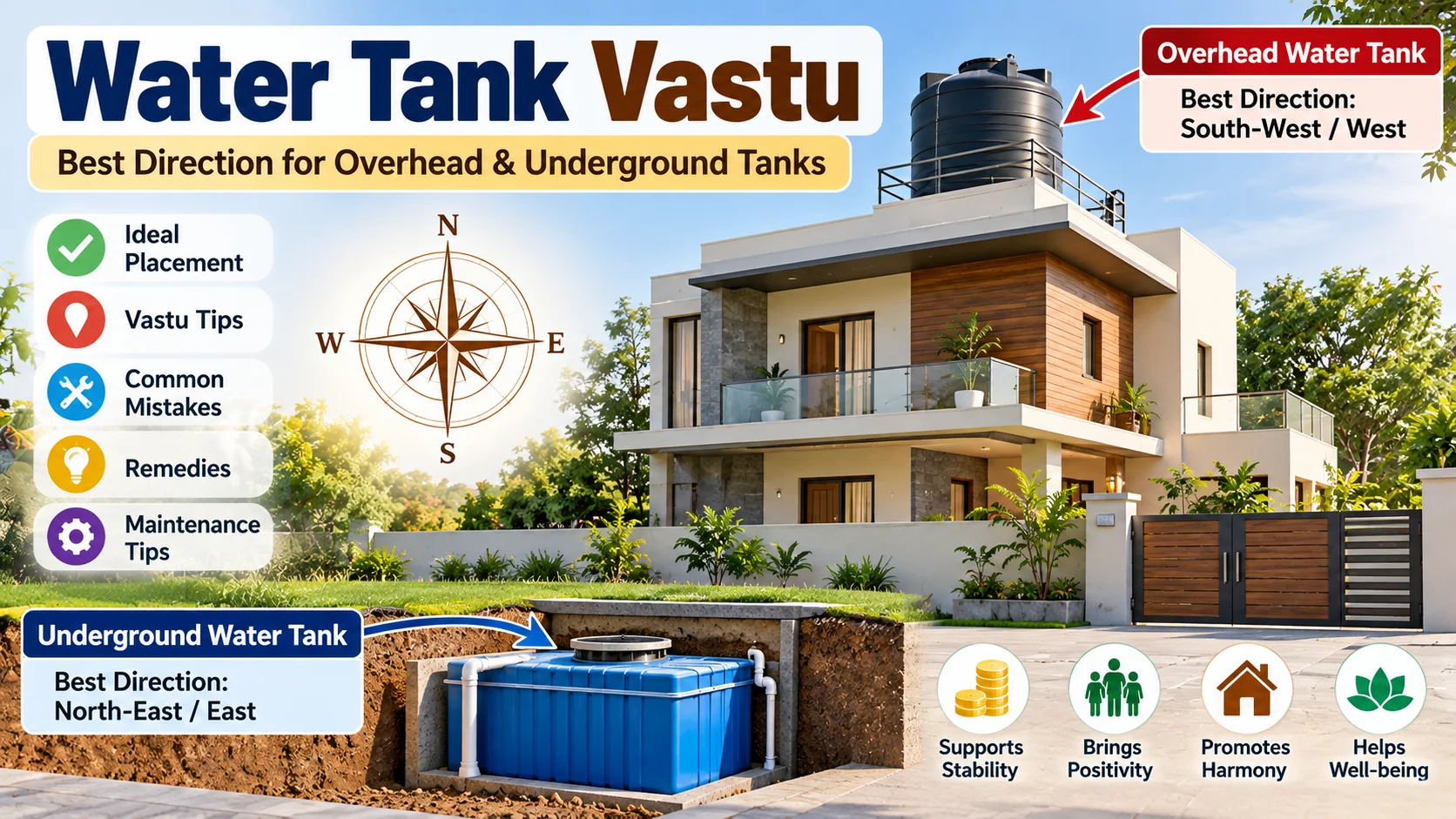
Water Tank Vastu focuses on the traditional Vastu guidelines used for placing overhead and underground water tanks in a home. Because water storage is an important part of house planning, Vastu gives different preferences for the location of each type of tank.
This article covers the commonly followed directions, placement considerations, maintenance tips and simple remedies for homes and apartments. These are traditional Vastu practices and should be considered alongside structural safety, plumbing requirements and practical site conditions.
Why Water Tank Placement Matters in Vastu
In traditional Vastu, water is associated with the water element and different parts of the property are given different characteristics. Overhead tanks are also heavy structures, so their placement is considered differently from underground water storage.
When planning a new tank, practical factors such as structural load, accessibility, waterproofing, drainage and maintenance should always be checked first.
Types of Water Tanks in Vastu
Overhead Water Tank
An overhead water tank is placed above the building and adds considerable structural load. Traditional Vastu commonly prefers the southwest or west for such heavy water storage.
Underground Water Tank
An underground tank is built below ground level. Traditional Vastu commonly associates the northeast and east with underground water storage.
Vastu Guidelines for Overhead Water Tank
Best Direction for an Overhead Tank
- Southwest: Commonly considered the preferred direction for a heavy overhead tank.
- West: Often considered another suitable option.
- Northeast: Traditionally avoided for heavy overhead structures.
- Centre of the house: Generally avoided for an overhead tank.
The final position should also be approved from a structural-engineering point of view because the tank and its supporting structure create significant load.
Colour and Maintenance
Traditional Vastu preferences may differ regarding tank colours. More important from a practical perspective is keeping the tank covered, clean and free from cracks or leakage.
- Keep the tank properly covered.
- Check for leakage and cracks regularly.
- Keep the surrounding roof area clean and accessible.
- Follow the manufacturer’s cleaning and maintenance recommendations.
Vastu Guidelines for Underground Water Tank
Best Direction for an Underground Tank
- Northeast: Traditionally considered the preferred location.
- East: Also commonly recommended.
- Southwest: Traditionally avoided for underground water storage.
- Southeast: Also generally avoided in traditional Vastu.
Before construction, waterproofing, drainage and soil conditions should be checked carefully so that the tank remains safe and functional.
Common Vastu Mistakes in Water Tank Placement
- Placing a heavy overhead tank in the northeast or centre according to traditional Vastu.
- Placing an underground tank in a traditionally avoided zone.
- Ignoring structural support for an overhead tank.
- Allowing the tank to remain uncovered, dirty or damaged.
- Ignoring leaks, seepage or poor drainage.
Remedies for a Water Tank in an Unfavourable Direction
Sometimes the tank location cannot be changed because of an existing building layout. In such cases, people following Vastu may use symbolic remedies or focus on improving the surrounding space.
- Keep the tank and surrounding area clean and well maintained.
- Repair leakage or visible damage promptly.
- Keep the surrounding area free from unnecessary clutter.
- Traditional symbols or Vastu products may be used according to personal belief.
These remedies should not be presented as guaranteed methods for changing financial, health or family outcomes.
Water Tank Vastu for Flats and Apartments
Residents of apartments often have no control over the location of the building’s main overhead or underground tank. In such situations, there is no need for major structural changes just to follow a Vastu preference.
- Keep the water-storage and plumbing areas properly maintained.
- Make sure there is no leakage or seepage inside the flat.
- Keep household drinking-water storage clean and covered.
- Focus on practical cleanliness and maintenance where structural placement cannot be changed.
Water Tank Vastu Direction Table
Tank Type Traditionally Preferred Direction Commonly Avoided Direction
Overhead Water Tank Southwest / West Northeast / Centre
Underground Water Tank Northeast / East Southwest / Southeast
Water Tank Maintenance Tips
Good maintenance is important whether or not you follow Vastu. A properly maintained tank protects water quality and the building.
- Clean the tank at suitable intervals.
- Keep it covered to reduce dust and contamination.
- Check pipes, valves and fittings for leaks.
- Inspect the supporting structure of an overhead tank.
- Address cracks, seepage and waterproofing problems without delay.
FAQs About Water Tank Vastu
Which direction is best for an overhead water tank?
Southwest is traditionally considered the preferred direction, with west also commonly mentioned as an option.
Which direction is best for an underground water tank?
Northeast is traditionally preferred, while east is also commonly recommended.
Can an overhead tank be placed in the northeast?
Traditional Vastu generally avoids placing a heavy overhead tank in the northeast. However, an existing building should not be altered without considering structural and practical requirements.
What should I do if my water tank is already in the wrong direction?
Relocation is not always practical. Focus on proper maintenance, leakage control and structural safety. Traditional symbolic remedies may be used as a matter of personal belief.
Does a leaking water tank create a Vastu problem?
Traditional Vastu may associate leakage with an unfavourable condition. Practically, leaks should always be repaired quickly because they can damage the building and waste water.
Can apartments follow Water Tank Vastu?
Yes, but residents may have little control over the building’s tank location. In such cases, focus on the parts of the water system and storage that you can safely control.
Structural Safety: Check the Water Tank Load First
An overhead tank adds a significant load to a roof or supporting platform. As a simple estimate, 1 litre of water weighs about 1 kilogram, so 1,000 litres of stored water weighs about 1 tonne. This is only the water weight; the tank, support frame, pipework and other loads add more. The load must be carried safely through the supporting structure.
Before installing a new tank, increasing its capacity or shifting an existing tank, ask a qualified structural engineer to check the slab, beams, columns, support arrangement and load path. Do not assume that a roof can safely carry a tank simply because another tank was previously installed there. Stop using an area and seek professional assessment if you notice unusual sagging, widening cracks, corrosion or persistent leakage around the support.
Water Tank Inspection and Maintenance Checklist
- Cover: Keep the tank securely covered so dust, insects, birds and other contaminants cannot enter.
- Inlet and overflow: Use suitable screening where needed and route overflow safely so it does not wet walls, foundations or electrical equipment.
- Leakage: Check the tank body, joints, valves and nearby pipework for seepage, drips or corrosion.
- Access: Provide safe access for inspection and cleaning. Do not climb an unstable support or enter a confined tank without appropriate precautions.
- Cleanliness: Inspect stored water and the inside of the tank periodically. Arrange cleaning when there is visible dirt, sediment, algae, contamination or as advised by the local water authority or a qualified service provider.
- Water quality: If water looks, smells or tastes unusual, do not assume that it is safe. Seek appropriate water-quality advice or testing before using it for drinking.
The Government of India notes that cleaning of overhead tanks is among the remedial actions when contamination is identified in drinking-water monitoring. See the Press Information Bureau update on drinking-water quality monitoring. For general building safety and structural design context, refer to the Bureau of Indian Standards National Building Code overview.
Before Choosing a Tank Location
Traditional Vastu may suggest the southwest or west for an overhead tank and the northeast or east for an underground tank. Treat these as traditional preferences. The actual location should be selected only after checking structural support, access for maintenance, pipe routes, drainage, waterproofing and the risk of contamination. Do not shift a tank or alter a supporting structure solely to follow a directional recommendation.
Water Tank Vastu is mainly concerned with the traditional placement of overhead and underground water storage. The southwest or west is commonly preferred for overhead tanks, while northeast or east is traditionally preferred for underground tanks. At the same time, structural safety, waterproofing, clean water storage and regular maintenance should remain the first priorities when planning or maintaining a water tank.