
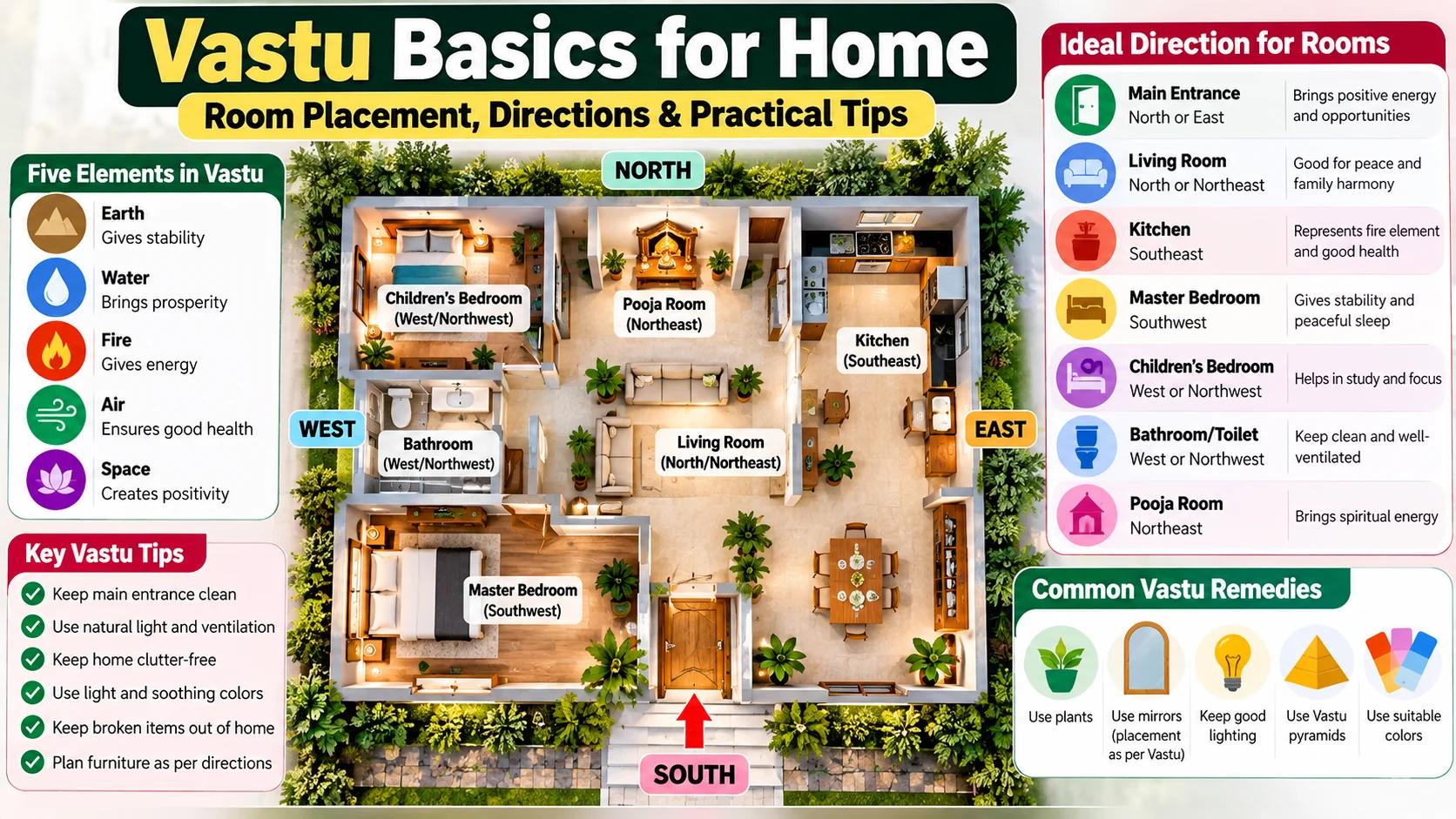
Vastu basics for home are traditional principles used to plan and arrange different parts of a house. They consider directions, room placement, open space, and the balance of five elements: earth, water, fire, air, and space. These ideas can be used while building, renovating, or arranging a home, along with practical factors such as ventilation, natural light, comfort, and easy movement.
What Are the Basics of Vastu for Home?
Traditional Vastu gives importance to the relationship between the five elements and the directions of a house.
- Earth: associated with stability
- Water: associated with flow and purity
- Fire: associated with energy and transformation
- Air: associated with movement and freshness
- Space: associated with openness
Directions also have traditional associations. North, East, South, and West are interpreted differently in Vastu-based planning.
Vastu Basics for Home Layout
Room placement is one of the main areas where traditional Vastu is applied.
| Area | Commonly Suggested Direction |
|---|---|
| Main Entrance | North or East |
| Living Room | North or Northeast |
| Kitchen | Southeast |
| Master Bedroom | Southwest |
| Children’s Room | West or Northwest |
| Bathroom | West or Northwest |
| Pooja Room | Northeast |

Main Entrance Vastu
The entrance is an important part of a Vastu-based home plan. Traditional Vastu commonly gives importance to the North and East directions for the main entrance.
For an existing home, keep the entrance clean, well maintained, and free from unnecessary storage. Good lighting and an unobstructed approach also make the entry more practical.
Living Room Vastu
North and Northeast are commonly suggested for the living room in traditional Vastu planning. Furniture can be arranged along the South or West side where practical, leaving enough open space for movement.
Use comfortable furniture and avoid overcrowding the room. Natural light and ventilation should also be considered.
Kitchen Vastu
The Southeast is traditionally associated with the fire element, so it is commonly suggested for the kitchen. Cooking while facing East is also suggested in traditional Vastu.
In practical terms, the kitchen should also have proper ventilation, safe electrical connections, and enough space for cooking and movement.
Bedroom Vastu
Traditional Vastu commonly recommends the Southwest for the master bedroom and West or Northwest for children’s bedrooms.
Traditional guidance also commonly suggests sleeping with the head toward the South and avoiding a mirror directly in front of the bed.
Bathroom and Toilet Vastu
West or Northwest are commonly suggested for bathrooms in traditional Vastu. Proper drainage and ventilation are also important.
Regardless of Vastu preferences, keeping the bathroom dry, clean, and well ventilated is important for everyday use.
Pooja Room Vastu
Northeast is traditionally preferred for a pooja room in many Vastu practices. The space should be kept clean, organized, and separate from unnecessary storage.
For homes where Northeast is not available, the prayer area can be planned within the practical constraints of the existing layout.
Vastu for a Modern Home
Traditional Vastu principles can also be combined with contemporary architecture, natural lighting, ventilation, energy-efficient practices, and functional use of space.
A useful approach is to consider Vastu preferences during planning while also prioritizing:
- Comfortable room sizes
- Good daylight
- Cross ventilation
- Safe electrical and plumbing systems
- Easy circulation
- Practical storage
Simple Vastu Tips for Every Home
- Keep rooms and storage areas organized.
- Remove broken or unused items regularly.
- Keep important pathways and entrances clear.
- Use adequate natural and artificial lighting.
- Maintain proper ventilation.
- Avoid overcrowding small rooms.
- Plan furniture according to the available space rather than forcing a layout.
Traditional Vastu Remedies
When structural changes are not possible, traditional Vastu practices may include the use of mirrors, plants, lighting, selected colours, or Vastu pyramids.
These are traditional approaches that some people use to address perceived Vastu imbalances.
They should not be treated as guaranteed methods for changing health, finances, relationships, or other life outcomes.
FAQs About Vastu Basics for Home
What are the main Vastu basics for a home?
The basic ideas include directions, room placement, the five elements, open space, cleanliness, and the arrangement of furniture and other important areas.
Which direction is commonly suggested for the kitchen?
Southeast is commonly suggested for the kitchen in traditional Vastu, as it is associated with the fire element.
Where should the master bedroom be placed?
The Southwest is commonly recommended for the master bedroom in traditional Vastu.
Can Vastu be used in an apartment?
Yes. Vastu principles can be adapted to apartments through practical adjustments and, where desired, traditional remedies.
Can Vastu be followed without structural changes?
Yes. Non-structural options such as furniture arrangement, lighting, colours, plants, and other traditional remedies can be considered.
Is Vastu a guarantee of health or financial success?
Vastu is a traditional system, so its recommendations should be viewed as guidance rather than a guarantee of specific results. Vastu is a traditional architectural and spatial-planning system, while health, finances, relationships, and other outcomes depend on many factors.