
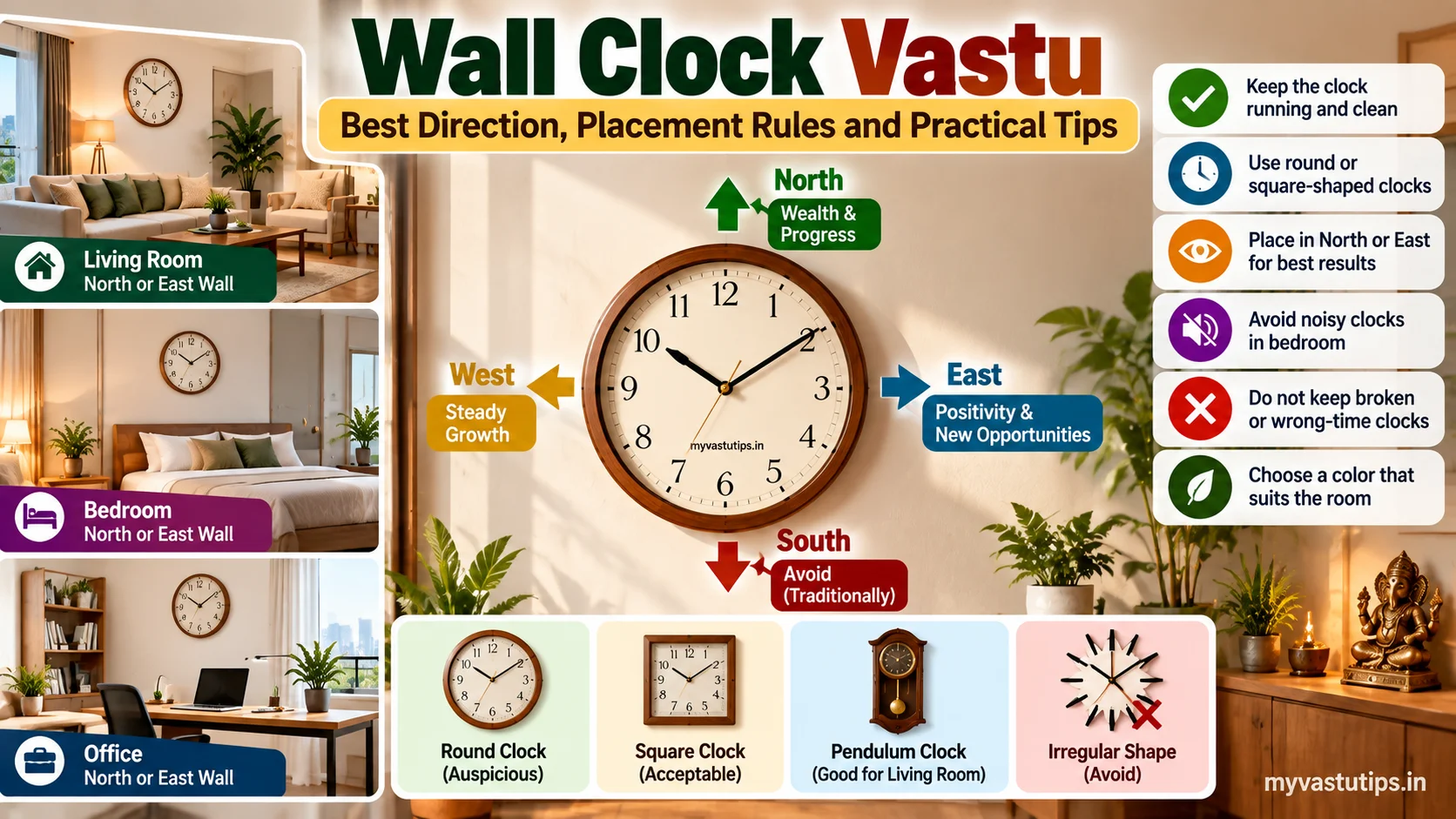
Wall Clock Vastu focuses on the traditional Vastu guidelines related to the direction, placement, shape and condition of a clock. A wall clock is also a practical part of home and office interiors, so its position should be convenient, easy to read and visually comfortable.
Traditional Vastu commonly gives preference to the north and east walls for clocks. These recommendations are best understood as Vastu traditions rather than guaranteed methods for changing wealth, health or personal outcomes.
Why Wall Clock Placement Matters in Vastu
In traditional Vastu, a clock represents the movement of time and is associated symbolically with progress and activity. Because of this, many people prefer to place clocks in directions considered favourable.
From a practical point of view, the most important factors are that the clock is easy to see, working correctly and placed where it does not obstruct doors, windows or movement.
Best Directions for a Wall Clock
North Direction
North is commonly preferred in traditional Vastu for a wall clock and is often associated with work, opportunities and financial activity.
East Direction
East is another commonly recommended direction. It is traditionally associated with the rising sun, freshness and new beginnings.
West Direction
West may also be used for a wall clock when it suits the room layout. The practical readability and placement of the clock should be considered first.
South Direction
Traditional Vastu often avoids placing clocks on the south wall. However, an existing clock in this direction does not need to be treated as a cause of problems.
Wall Clock Vastu for Different Rooms
Bedroom
- North or east walls are commonly preferred.
- Place the clock where it can be read easily without disturbing sleep.
- Avoid a loud ticking clock if it affects your rest.
- Keep the clock working correctly and properly maintained.
Living Room
- North or east is traditionally preferred.
- Choose a location that is clearly visible to family members.
- Avoid placing the clock where it blocks artwork, windows or movement.
- Keep the surrounding wall clean and uncluttered.
Office
- North or east are commonly preferred in traditional Vastu.
- Place the clock where employees can easily see it.
- Avoid locations that interfere with doors, shelves or equipment.
- Use a simple, readable design for practical time management.
Best Shape of Wall Clock as per Vastu
Round clocks are commonly preferred in traditional Vastu because their continuous shape is associated with completeness and movement. Square or rectangular clocks can also be used when their design suits the room.
The shape should ultimately match the room and your personal preference. A clock should be easy to read and well maintained rather than chosen only for its symbolic meaning.
Wall Clock Vastu Do’s and Don’ts
Do’s
- Keep the clock clean and working.
- Make sure it shows the correct time.
- Choose a clearly visible location.
- Prefer north or east if you follow traditional Vastu.
- Select a size that suits the wall and room.
Don’ts
- Do not keep a broken or permanently stopped clock.
- Avoid placing the clock where it can fall or become difficult to maintain.
- Do not block doors, windows or walking paths.
- Avoid excessive numbers of clocks showing different times.
Wall Clock Vastu Placement Table
| Location | Traditional Preference | Practical Tip |
|---|---|---|
| Living Room | North / East | Keep the clock clearly visible |
| Bedroom | North / East | Place it where it does not disturb sleep |
| Office | North / East | Keep it easy to read from the work area |
| West Wall | Acceptable | Use when it suits the room layout |
| South Wall | Traditionally avoided | An existing clock here does not need to be changed because of fear |
What to Do About a Clock in an Unfavourable Direction
Changing the position of a clock is usually simple. If you follow Vastu and the clock is in a traditionally less-preferred direction, you can move it to a north or east wall when practical.
There is no need for expensive remedies. A clean, working clock placed safely and conveniently is the most practical approach.
Does Clock Colour Matter in Vastu?
Traditional Vastu sometimes recommends different colours for different directions, but there is no need to choose a colour that makes the room uncomfortable. Select a clock colour that works well with the wall, lighting and interior design.
Neutral, metallic and natural shades can suit many interiors, while brighter colours may be used as accents.
Common Wall Clock Mistakes
- Keeping a clock that shows the wrong time.
- Using a damaged or non-working clock as decoration.
- Placing the clock too high or too low for easy reading.
- Choosing a noisy clock for a quiet bedroom.
- Using too many clocks in one room.
- Placing the clock where it interferes with doors or windows.
Psychological and Practical Considerations
A visible clock can encourage awareness of time and help with daily routines. In a bedroom, however, constantly checking the time may feel distracting for some people. In a workspace, an easy-to-read clock can be useful for scheduling tasks.
These practical effects are different from traditional Vastu beliefs about energy and should not be presented as scientific proof of Vastu principles.
FAQs About Wall Clock Vastu
Which direction is best for a wall clock?
North and east are the most commonly preferred directions in traditional Vastu.
Can I place a wall clock in the bedroom?
Yes. North or east walls are commonly preferred. Choose a quiet clock if ticking noise affects your sleep.
Is a wall clock on the south wall bad?
Traditional Vastu often avoids the south wall for clocks, but an existing clock there should not be treated as a guaranteed cause of problems.
What shape of wall clock is best?
Round clocks are commonly preferred in traditional Vastu. Square and rectangular clocks can also be used according to the room and interior design.
Should a wall clock always show the correct time?
Yes. A working clock showing the correct time is more useful and practical than a stopped or inaccurate clock.
Can I use a digital wall clock?
Yes. A digital clock can be used in the same practical locations as an analogue clock. Readability and convenience should be considered.
Safe Wall Clock Installation Checklist
A wall clock should be easy to read and securely fixed. Before installing it, consider these practical points:
- Choose the right wall fixing: Use a screw, wall plug or fixing suitable for the wall material and the clock’s weight. Do not rely on a weak adhesive for a heavy clock.
- Avoid fall hazards: Do not hang a heavy clock above a bed, frequently used seat or busy passage where a fall could injure someone.
- Check visibility: Place the clock where people can read it from the main seating or work area without needing to turn awkwardly.
- Control glare: Avoid direct sunlight or bright reflections that make the clock face difficult to read.
- Keep access in mind: Leave doors, windows, cupboards and ventilation openings unobstructed.
- Maintain the clock: Replace batteries when needed, correct the time after power interruptions and repair loose hands or damaged fittings.
Clock Placement in Different Spaces
In a living room, the clock should be visible from common seating without dominating the wall. In a bedroom, choose a quiet model and place it where its light or ticking does not disturb sleep. In an office, use a clear display that can be read from the work area. These practical factors matter regardless of whether you follow the traditional north- or east-wall preference. For room arrangement ideas, see our living room Vastu guide and office Vastu guide.
Do You Need to Move a Clock on a Traditionally Avoided Wall?
No urgent action is needed just because a clock is on the south or another direction that a particular Vastu tradition does not prefer. If you choose to follow the traditional recommendation, move it only when another position is safer and more convenient. Avoid costly remedies or making holes in a wall without checking for concealed wiring or plumbing.
Wall Clock Vastu is mainly about traditional preferences for direction, placement and symbolism. North and east are commonly preferred, while a clean, working and safely placed clock is the most practical choice. Vastu can guide your preference, but there is no need to make expensive changes because of fear about a clock’s location.